Who is a Suitable Candidate for Hair Transplant? Understanding Eligibility
Hair transplantation is a life-changing procedure, but success depends heavily on individual suitability and the quality of your donor area.
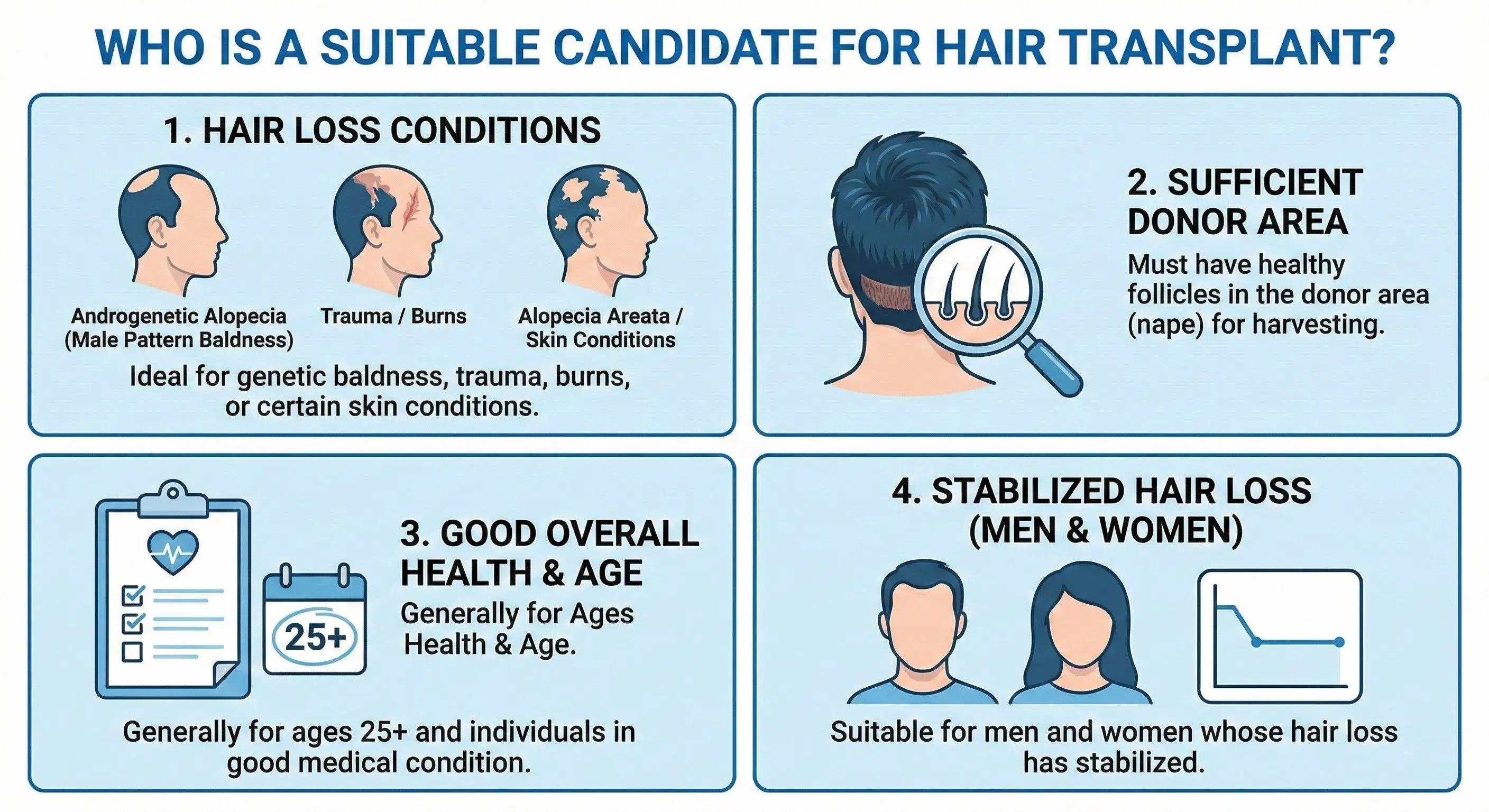
This procedure is ideal for individuals with androgenetic alopecia (male-pattern baldness), or hair loss due to trauma, burns, and certain skin conditions like alopecia areata. Candidates must have a sufficient donor area with healthy follicles and be in good overall health. While generally recommended for individuals aged 25 and over, it is suitable for both men and women whose hair loss has stabilized.
Candidacy Checklist
- ✅ Stabilized Hair Loss: Ideally after the age of 25.
- ✅ Strong Donor Supply: Healthy follicles in the nape area.
- ✅ Good Health: Fit for a minor surgical procedure.
Key Factors for Suitability
To achieve the best possible results, several technical and physiological criteria are evaluated by our specialists during the consultation phase.
1. Types of Hair Loss
The most common candidates are those with androgenetic alopecia (male-pattern baldness). However, hair transplantation is also effective for hair loss due to trauma, burns, and specific skin conditions like alopecia areata, provided the condition is stabilized under medical supervision.
2. The Importance of the Donor Area
Success is limited by the "supply." Candidates must have a sufficient donor area with healthy follicles to cover the thinning or bald regions effectively. Our experts use advanced mapping to ensure donor area health is preserved for a natural look.
3. Age and Perspective
While generally recommended for individuals aged 25 and over, the most critical factor is the stabilization of the hair loss pattern. This ensures that the transplanted hair maintains its aesthetic harmony as the patient ages.
Suitable for Both Men and Women
It is a common misconception that hair transplants are exclusively for men. Women experiencing female-pattern thinning or those seeking to adjust their hairline are often excellent candidates, benefiting from the same precision techniques like DHI.
Conclusion
Determining if you are a suitable candidate is the foundational step of your transformation. Through a detailed scalp analysis and medical review, we ensure that every patient we treat has a high probability of achieving a dense, natural, and permanent result.
Frequently Asked Questions
At what age is it best to get a hair transplant?
Technically, anyone over 18 can have it, but we generally recommend waiting until at least 25. This allows your hair loss pattern to stabilize, ensuring we plan a hairline that will look natural for the rest of your life.
Do I need to be completely bald to have a transplant?
No, you do not need to be completely bald. In fact, it is better to have the procedure while you still have a healthy donor area. We can increase density in thinning areas.
What if my donor area is weak?
A strong donor area (usually the back of the head) is crucial. If your scalp donor supply is insufficient, we may evaluate the possibility of using body hair (beard or chest) as an alternative source, though this is decided on a case-by-case basis.
Recommended Reading
This information is for informational purposes only and does not constitute medical advice. Please consult your physician.