FUE vs DHI Transplant: Which Fits You?
Compare FUE vs DHI transplant methods, healing, density, shaving, and cost so you can choose the right hair restoration approach with confidence.
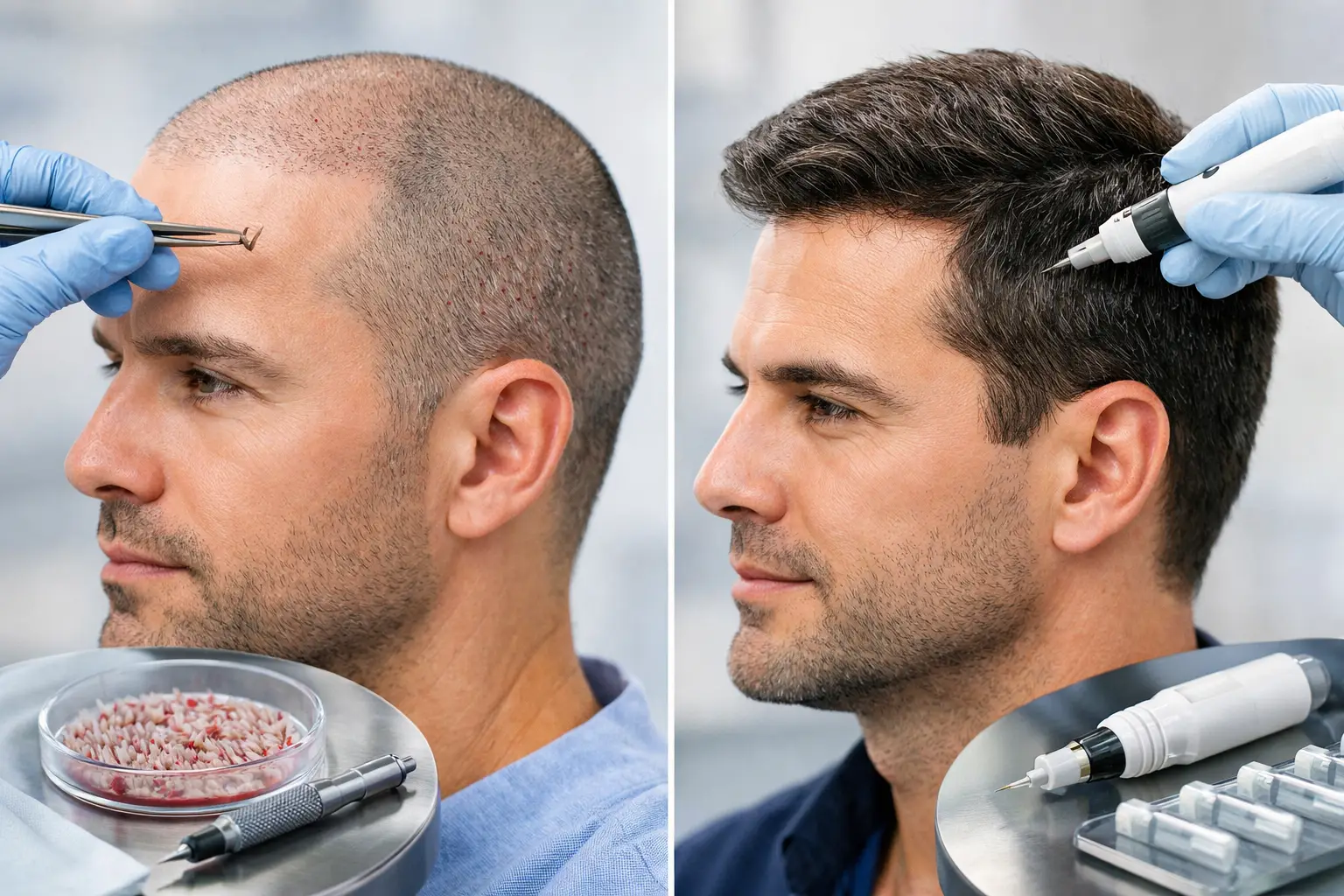
A hair transplant is not just about moving follicles. It is about how natural your hairline will look in daylight, how much of your donor area is preserved for the future, and how comfortable you feel through recovery. That is why the FUE vs DHI transplant question matters so much. The right choice depends less on marketing terms and more on your hair loss pattern, donor strength, styling goals, and the surgeon’s planning.
For many patients, the confusion starts because FUE and DHI are often presented as if they are completely different procedures. They are not. DHI is best understood as a variation within the FUE family. In both methods, individual grafts are typically extracted from the donor area, usually at the back of the scalp. The main difference is how those grafts are placed into the recipient area.
FUE vs DHI transplant: what actually changes?
In a standard FUE procedure, the surgeon extracts follicles one by one, then creates tiny channels in the recipient area before implanting the grafts. This gives the medical team a high degree of control over angle, direction, and overall design. It is a widely used method because it is versatile and effective across many hair loss patterns.
In DHI, the extracted follicles are loaded into a specialized implanter pen and inserted directly into the scalp. Instead of making all recipient channels in advance, the surgeon can create the site and place the graft in one motion. This approach can allow very precise placement, especially in smaller or detail-focused areas such as the hairline, temples, or crown refinement.
That sounds straightforward, but it does not mean DHI is automatically better. The real advantage depends on the case. A highly experienced surgeon can create excellent, natural results with either technique, while a poorly planned procedure can disappoint regardless of the method used.
Who is a better candidate for FUE?
FUE is often the more flexible option for patients who need coverage over a larger area. If your recession extends across the front and mid-scalp, or if you have more advanced thinning, FUE may make practical sense because it is efficient and adaptable. It can also be a strong choice when the treatment plan requires a high graft count.
Another reason FUE remains popular is that it works well for broad reconstruction. If the goal is to rebuild the frontal zone, restore density through the mid-scalp, and use the donor supply strategically, standard FUE offers room for careful distribution. This matters because hair restoration is rarely only about today. A good plan protects your donor area for future needs.
FUE can also be well suited for patients who are comfortable shaving the donor area and, in many cases, part of the recipient area. That level of preparation often makes extraction and placement more efficient. For some patients, that is a small trade-off for a larger session.
When DHI may be the stronger choice
DHI is often attractive to patients who want refined work in a more concentrated area. If the priority is a softer hairline, targeted temple work, or adding density between existing hairs, the implanter pen can be useful because it supports controlled placement in tight spaces.
This can make DHI appealing for women and for men with early-stage thinning who still have significant native hair. In these cases, the challenge is not just filling a bald area. It is placing grafts among existing hairs without creating unnecessary disruption.
Some patients also prefer DHI because it may allow less shaving in select cases, depending on the surgeon’s technique and the treatment area. That can be an important practical factor for professionals who want a more discreet recovery. Still, this is not guaranteed in every clinic or every case, so it should be discussed early rather than assumed.
Density, naturalness, and the myth of one “best” method
Many people ask whether DHI gives better density than FUE. The honest answer is that density is not created by the label of the technique alone. It comes from donor quality, graft survival, the surgeon’s design, placement skill, and realistic planning.
DHI can offer very precise implantation, which may help in high-visibility zones. FUE, however, can also create excellent density when the channel creation and graft placement are done with expertise. In experienced hands, both methods can look natural and full.
What matters most is whether the surgeon is choosing the method to serve your anatomy or simply selling the most marketable option. If a clinic claims one technique is universally superior, that is usually a sign to ask harder questions.
Recovery and scarring
Both FUE and DHI are considered minimally invasive compared with older strip methods. In both approaches, patients can expect small scabs in the recipient area, temporary redness, and a healing period that usually unfolds over days rather than weeks. Tiny dot scars in the donor area are also expected after follicle extraction, although these are typically very difficult to detect once the hair grows out.
Recovery differences between FUE and DHI are often overstated. Some clinics suggest DHI is significantly easier to heal from, but for most patients the experience is fairly similar. The more important variables are the size of the session, the sensitivity of your scalp, how carefully the grafts were handled, and whether you follow aftercare instructions closely.
That is why structured aftercare matters. Hair transplantation does not end when the procedure is finished. Shedding, growth cycles, washing guidance, swelling management, and follow-up all shape the experience. Patients traveling abroad often feel more at ease when these steps are organized clearly and supported beyond the first few days.
Cost differences and what they really mean
DHI is often priced higher than standard FUE, but higher price does not always equal better value. DHI can require more time, a different implantation workflow, and a team specifically trained in that technique. Those factors can raise the package cost.
At the same time, the cheapest option is rarely the safest option in hair restoration. If pricing feels unusually low, it is worth asking who performs the critical parts of the procedure, how graft numbers are estimated, whether the clinic is accredited, and what support is included after you return home.
For international patients, this is where the full treatment journey matters. Transparent package pricing, multilingual coordination, complication coverage, and reliable aftercare can be just as important as the procedure itself. In a destination such as Istanbul, where hair transplantation is highly developed, the difference between a premium medical journey and a risky bargain often comes down to standards, surgeon selection, and continuity of care.
Questions worth asking before you choose
The most useful consultation is not the one that pushes a method. It is the one that explains why a specific method suits your case. Ask whether your donor area is strong enough for the proposed graft count. Ask whether your hairline design is age appropriate. Ask who will perform extraction, channel opening, and implantation. Ask what happens if your hair loss progresses in the next five years.
You should also ask to see results on patients with a similar hair type, skin tone, and level of hair loss. A great result on someone else does not automatically predict a great result for you. Candidacy is personal.
So, which should you choose?
If you need broader coverage, a larger session, or a versatile approach to more advanced hair loss, FUE may be the more practical fit. If you want highly detailed placement, less shaving in select cases, or careful work between existing hairs, DHI may be the better route.
The safest answer, however, is not to choose a method first and then look for a clinic. Choose the right surgeon and care pathway first. The best providers assess your scalp, donor capacity, long-term hair loss pattern, and recovery priorities before recommending a technique.
That is the difference between buying a procedure and beginning a well-planned transformation. A good hair transplant should look natural now, age well later, and leave you feeling protected at every stage of the journey.
This information is for informational purposes only and does not constitute medical advice. Please consult your physician.
